
📋 TL;DR
A simple guide for founders to understand the P&L, balance sheet, and cash flow — plus 5 numbers to track monthly. You don't need to become an accountant. You just need to read three statements with confidence.
Let's be honest: most founders didn't start a company because they love spreadsheets.
You started because you spotted a gap in the market, had a better idea, or simply couldn't sit through someone else's strategy meeting one more time. But here's the uncomfortable truth — your financials are the scoreboard of everything you're building. Ignore them, and you're flying blind. Worse, you're making decisions on gut feel when the data is sitting right there, waiting for you to look.
The good news? You don't need a finance degree. You don't need to memorise accounting standards. You need to understand three statements and track five numbers. That's it. Five minutes of reading now could save you months of cash-flow surprises later.
Here's your no-jargon, UAE-focused guide to financial literacy for founders.
1. The Profit & Loss Statement: Are You Actually Profitable?
The P&L (also called the Income Statement) answers the most fundamental question in business: did you make money, or lose it, over a given period?
Think of it like peeling an onion. You start with total revenue at the top, and each layer strips away a different category of cost — until you're left with net profit (or net loss) at the bottom. The headline number matters, but the real story is in the layers.
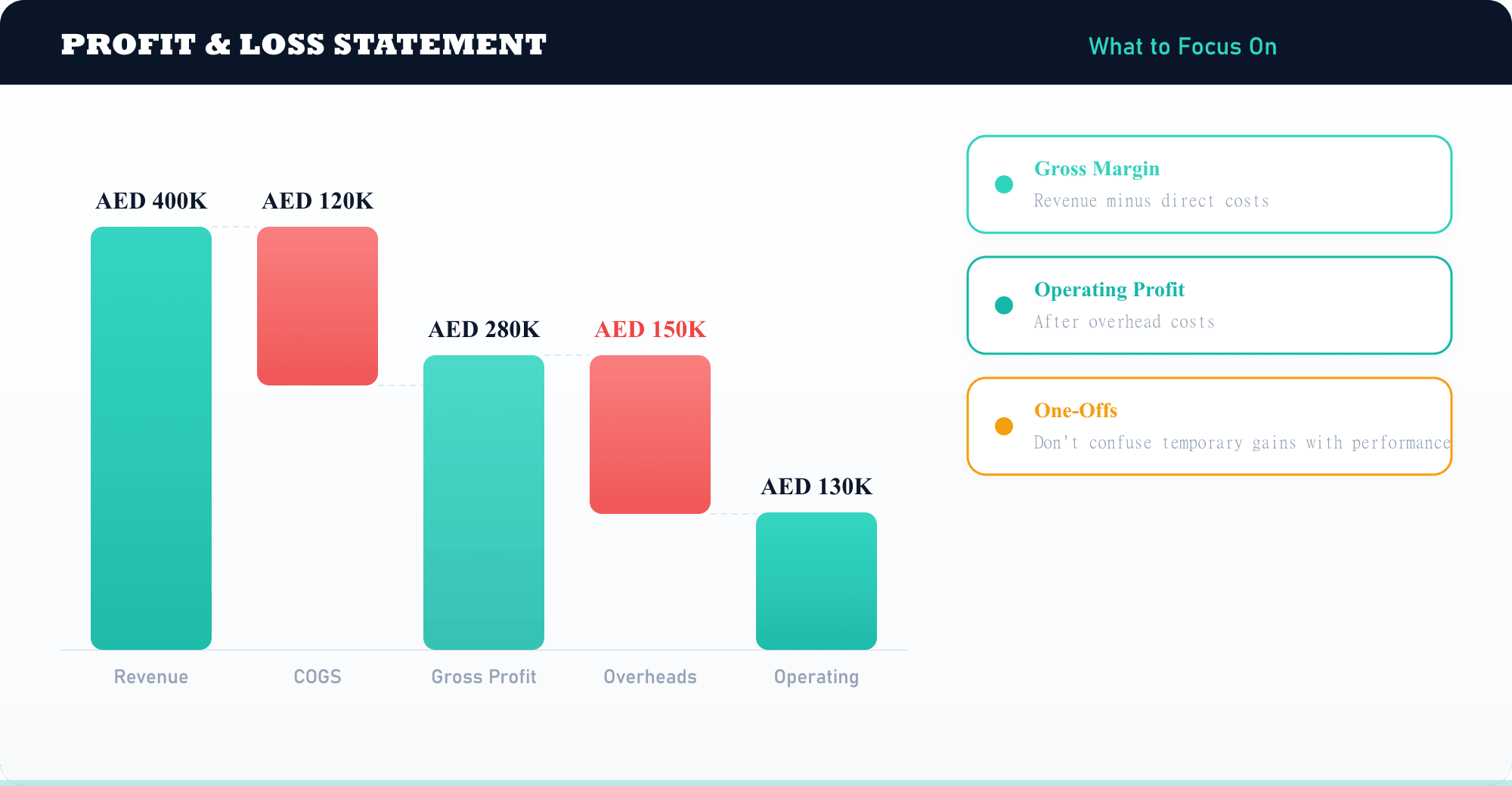
What to Focus On:
Gross Margin — This is your revenue minus the direct costs of delivering your product or service (known as COGS). If you're a services firm, think consultant salaries. If you're in retail, think purchase cost of stock. A healthy gross margin tells you your core business model works. If this number is thin, no amount of sales growth will save you — you'll just be scaling a loss.
Operating Profit — After gross profit, you subtract overhead: office rent, admin salaries, marketing spend, software subscriptions, and every other cost of keeping the lights on. What's left is your operating profit. This is the real measure of how efficiently you run the business day-to-day. A company with strong gross margins but razor-thin operating profit has a spending problem, not a revenue problem.
One-Offs — Every P&L has noise. Maybe you sold an old vehicle, received a one-time insurance payout, or took a write-down on equipment. These items distort the picture. Train yourself to ask: "Is this repeatable?" If the answer is no, mentally strip it out when judging performance. Confusing a windfall with operational strength is one of the most common founder mistakes.
💡 Founder Tip
Ask your accountant to add a column showing last month and the same month last year. Two comparisons tell you whether you're trending up and whether seasonality is at play.
2. The Balance Sheet: What's Stuck?
If the P&L is a movie (showing performance over time), the balance sheet is a photograph — a snapshot of what you own, what you owe, and what's left over at a single point in time.
The equation is beautifully simple: Assets = Liabilities + Equity. If it doesn't balance, something has gone wrong.
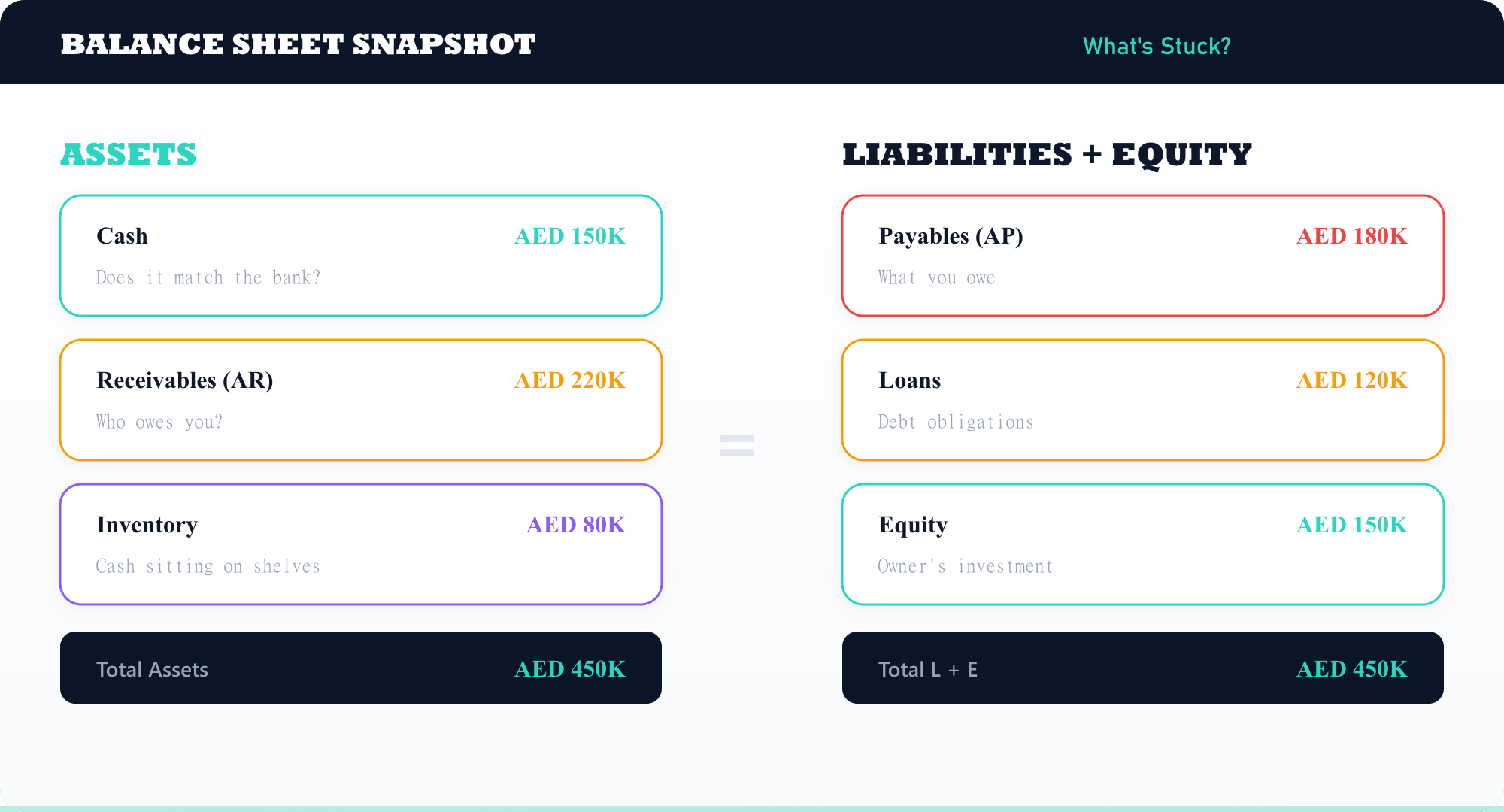
The Four Lines Founders Must Watch:
Cash — The most obvious one, and the most misread. Your balance sheet shows cash at a point in time. Cross-check it against your actual bank statement. If the numbers don't match, find out why — it could be timing, or it could be an error you need to catch early.
Receivables (AR) — This is money your customers owe you. High receivables mean you're doing the work, but the cash hasn't landed. In the UAE, extended payment terms are common (30, 60, even 90 days). Track who owes you and how long they've owed it. Aged receivables are the silent killer of otherwise profitable businesses.
Payables (AP) — The mirror image — what you owe suppliers, landlords, and service providers. Managing the timing between when you collect from customers and when you pay suppliers is the essence of working capital management.
Inventory — If you hold physical stock, every unit sitting on a shelf is cash you've spent but haven't recovered yet. Think of inventory as frozen cash. The longer it sits, the more it costs you in storage, obsolescence risk, and opportunity cost.
⚠️ Key Insight
If your P&L shows profit is up but your bank account is shrinking, the answer is almost always on the balance sheet. Either your receivables have ballooned (customers are paying slower) or your inventory has grown (you've bought more stock than you've sold). The balance sheet is where cash goes to hide.
3. The Cash Flow Statement: Why Cash Moved
This is the statement most founders skip — and the one they need most. The cash flow statement explains why your bank balance changed from the start of the period to the end. Not whether you're profitable on paper, but whether real dirhams moved in or out.
Think of it in three buckets:
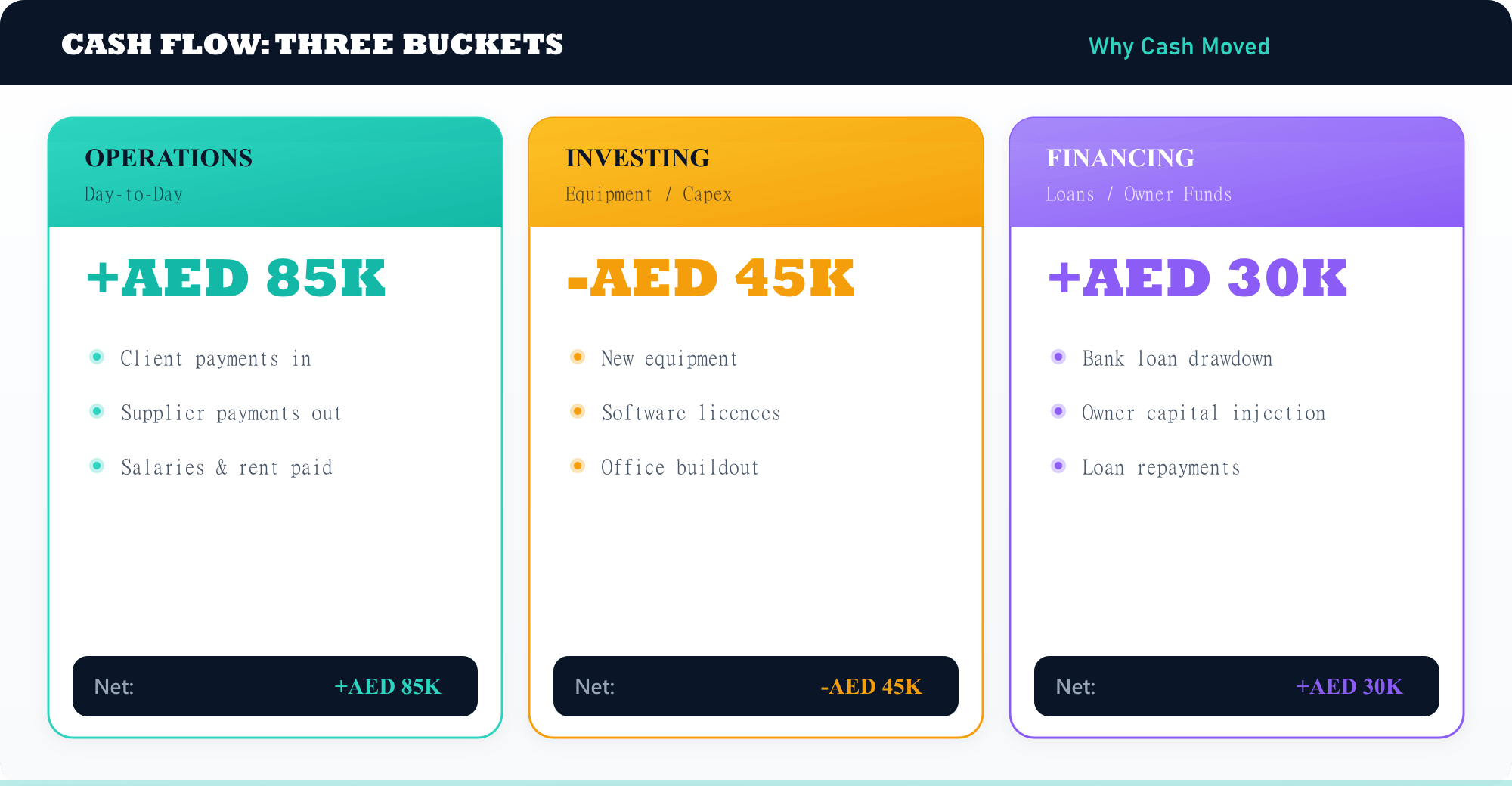
The Three Buckets:
Operations — Cash generated (or consumed) by your day-to-day business. Client payments coming in, supplier payments going out, salaries, rent, utilities. This is the heartbeat. If operating cash flow is consistently negative, the business is burning through cash regardless of what the P&L says.
Investing — Cash spent on long-term assets: new equipment, vehicles, fit-out costs, technology buildouts. A big negative number here isn't necessarily bad — it means you're investing in growth. But it does mean you need operating cash flow or financing to cover it.
Financing — Cash from loans, credit facilities, or owner injections — minus any repayments or dividends. If you're relying heavily on financing to cover operations, that's a red flag. It means the business isn't self-sustaining yet.
💡 Founder Tip
A healthy, growing business typically shows positive operating cash flow, negative investing cash flow (you're reinvesting), and minimal financing activity. If all three buckets are negative, it's time for a serious conversation with your finance team.
The 5 Numbers Every Founder Should Track Monthly
You don't need a 40-page management report. You need five numbers on your desk by the 10th of every month. If these five are moving in the right direction, your business is healthy. If any of them start drifting, you'll catch it early enough to act.
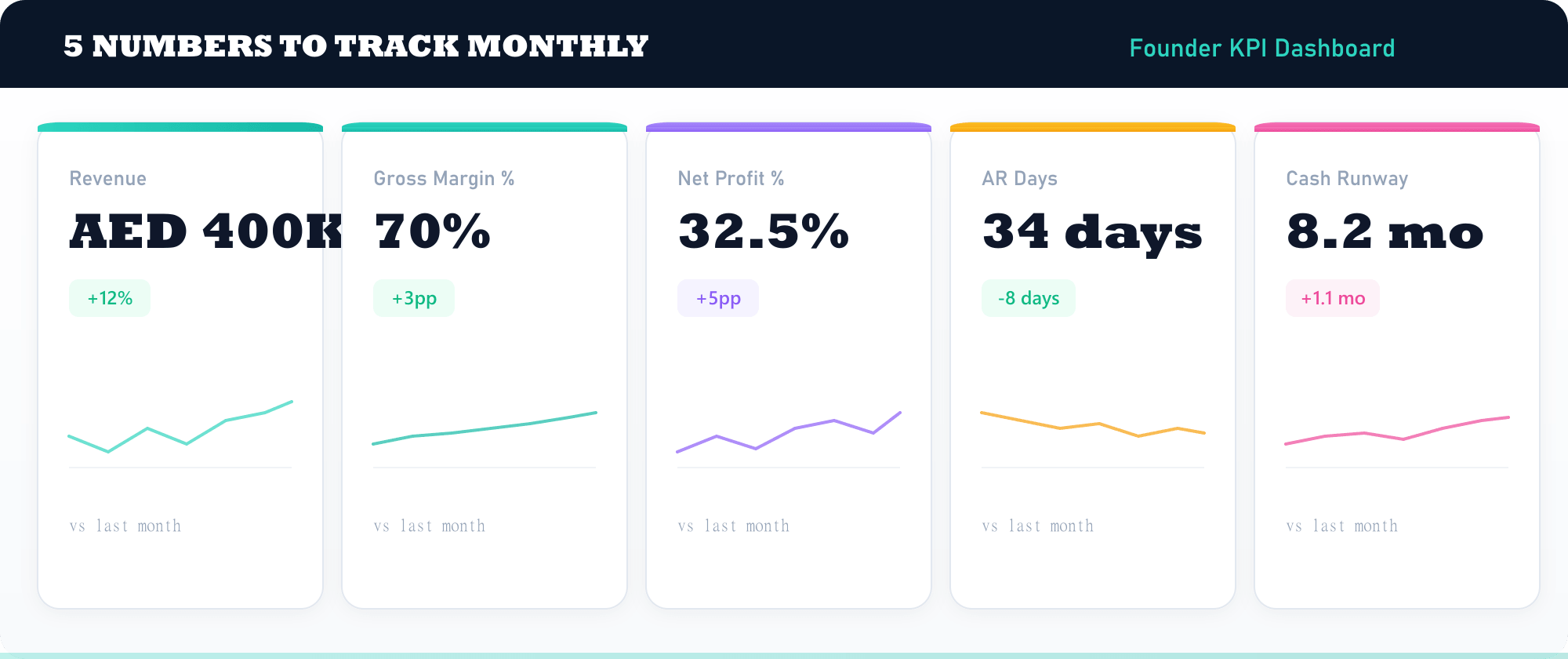
| KPI | What It Tells You | Why It Matters |
|---|---|---|
| Revenue | Top-line growth | Is the business growing? Compare month-on-month and year-on-year to separate real growth from seasonal bumps. |
| Gross Margin % | Unit economics | Are you making money on every sale before overhead? If this is shrinking, your pricing or cost structure needs attention. |
| Net Profit % | Bottom-line health | What percentage of every dirham earned hits the bottom line? This is the ultimate efficiency metric. |
| AR Days | Collection speed | How many days on average do customers take to pay? In the UAE, benchmark against your agreed terms (30/60/90 days). |
| Cash Runway | Survival horizon | How many months can you operate at current burn rate? Below 3 months means urgent action is needed. |
📊 Quick Formulas
Net Profit % = Net Profit / Revenue x 100
AR Days = (Accounts Receivable / Revenue) x Days in Period
Cash Runway = Cash Balance / Average Monthly Burn Rate
Bringing It All Together
These three statements aren't separate documents — they're three views of the same reality. The P&L tells you if you're making money. The balance sheet tells you where the money is. The cash flow statement tells you why it moved.
When you read them together, patterns emerge. You'll spot the client who hasn't paid in 90 days. You'll notice inventory creeping up faster than sales. You'll see that last month's "record profit" was actually a one-off gain masking flat performance.
That's not accounting. That's leadership.
The founders who build the most durable companies aren't the ones who hand off their finances and forget about them. They're the ones who spend 15 minutes a month reading these three statements, asking the right questions, and making better decisions because of it.
What Daira Can Do for You
At Daira, we don't just prepare your financial statements — we make sure you actually understand them. Our OneFinance platform connects to your accounting software and delivers a real-time dashboard with the exact KPIs covered in this article. No more waiting until month-end. No more decoding spreadsheets.
Whether you're an early-stage startup tracking cash runway or an established SME optimising gross margins, we build the financial visibility layer that lets you lead with confidence.
Book Your Free Walkthrough
Topics